An AI receptionist that answers the phone.
FirstReply is our own AI receptionist, and it answers our office line, (916) 618-0502. It checks who is calling, books a time on our calendar while the caller is still on the line, and sends the owner a written summary in Telegram. We designed and built all of it, and we adapt it to a client's own phone line and CRM.
Built per client and sold as a project.
- Project
- Our own product, on our office line
- Our work
- Design, development, phone setup, hosting
- Timeline
- Since June 2026, ongoing
- Stack
- Python, FastAPI, PostgreSQL, Telnyx, Cal.com, Telegram
- Status
- Live on (916) 618-0502
What the owner gets
From the first ring to the written summary, in four steps.
-
A person answers first
With ring-first switched on, the business's own phone rings first, for 18 seconds by default. If nobody picks up, the assistant takes the same call.
-
It knows who is calling
While the phone rings, the number is looked up in our CRM. A known caller is greeted by name from the first words.
-
Booking happens on the call
The assistant reads open times from the Cal.com calendar and books one while the caller is still on the line, then confirms the day and time out loud.
-
The owner follows in Telegram
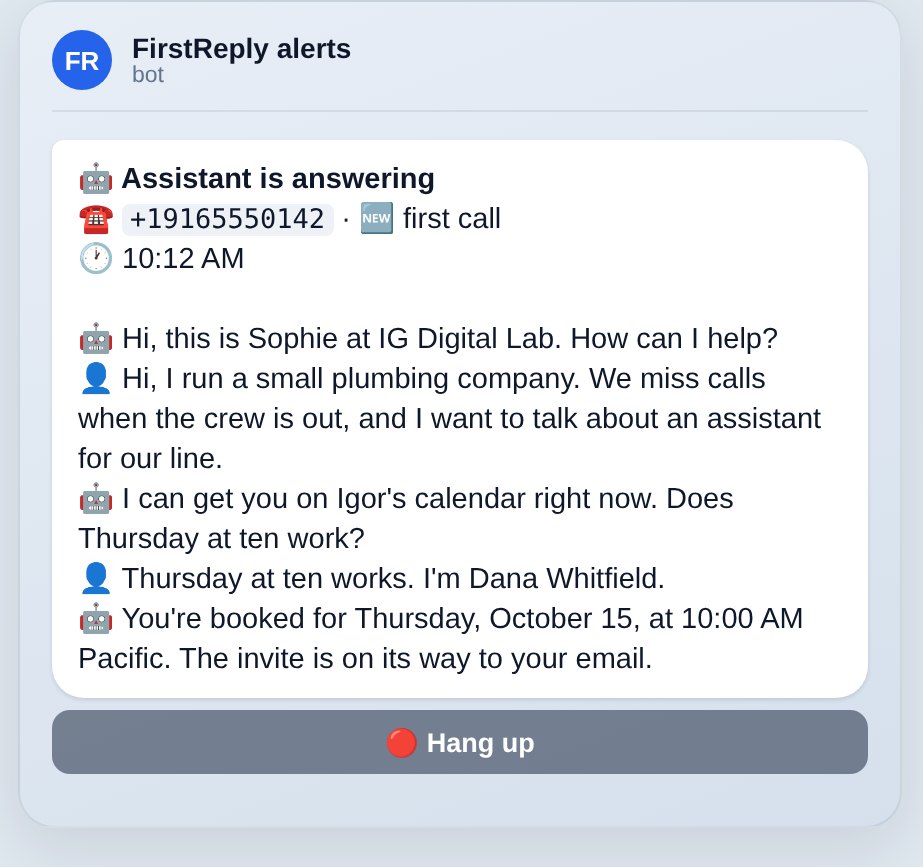
While the assistant is on the call, its transcript appears in a Telegram message as it is spoken, with a Hang up button beside it. A written summary follows when the call ends.
What comes out
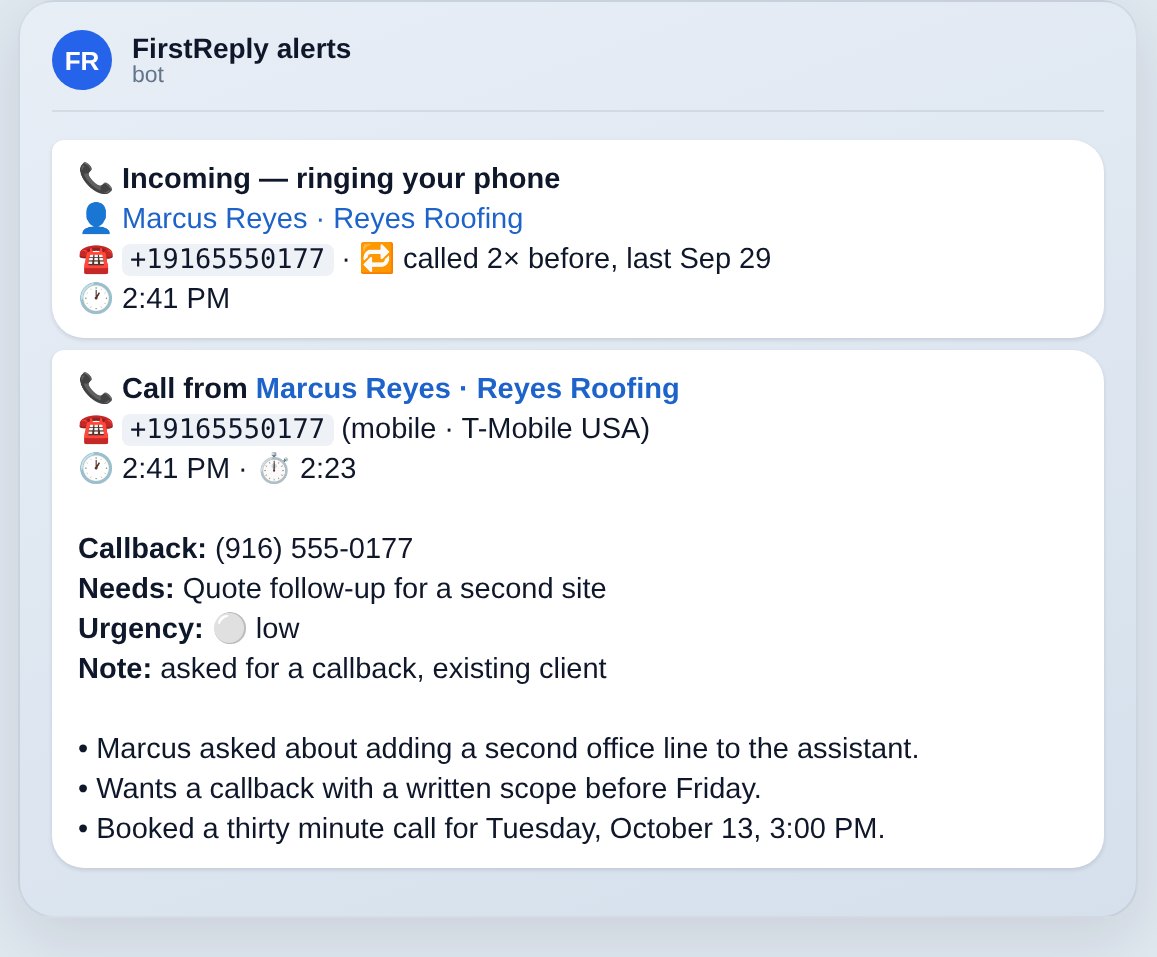
Two moments of one fictional call: the ringing notice, then the summary that follows it. Both are produced by the product's own message code.
- A known caller shows up by name from the CRM, with how many times they have called before.
- The summary lists the callback number, what the caller needs and how urgent it is. A detail the caller never gave is left out, not guessed.
- The number is plain text you can tap to copy, with the line type and carrier next to it.
- While a call is live, the first message is edited in place from ringing to answered to finished. The written summary arrives right after.
How it stays reliable
A phone line has no second chance at a first impression. Four rules built into the code.
No notice, no recording
One switch turns on the spoken recording notice and the recording together. If the notice text is empty, recording does not start, and an automated test checks every way a call can begin. The notice always plays before any recording begins.
Contacts need a tap
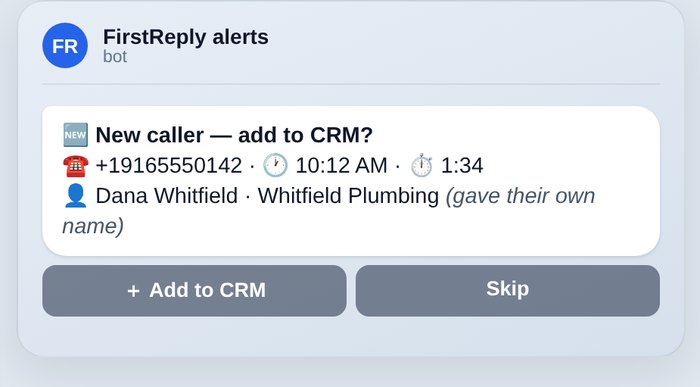
A number that just held a real conversation can look like a new customer or like a robocall. So nothing is written to the CRM automatically: the owner gets an Add to CRM button, and only a tap creates the contact.
The call never waits on software
The CRM lookup and the Telegram messages run beside the call, and the spam check lets the call through if it breaks. If any of them is slow or fails, the caller still gets an answer.
Silence alone gets a number blocked
A number is blocked automatically only after three calls in which nobody said a word. A caller who has spoken even once is never blocked this way: turning away one real customer costs more than a few robocalls.
What happens when your phone rings and nobody picks up?
We build a version for your own phone line and CRM, with booking into your Cal.com calendar, and price it as a project.
Tell us what's slowing you down.
We reply the same business day.